My Account





The American Gold Eagle may look like a modern gold coin, but its story reaches back to one of the most celebrated periods in American coinage. First introduced in 1986, the coin brought together the value of gold bullion with a Liberty design inspired by Augustus Saint-Gaudens. That connection gave the American Gold Eagle an identity that goes beyond its precious-metal content.
Since its launch, the coin has continued to evolve. Its original eagle-and-nest reverse remained for more than three decades before the U.S. Mint introduced a new reverse design in 2021. But what inspired the American Gold Eagle, and how did it become one of America’s best-known gold bullion coins?
Where the American Gold Eagle Story Begins
The modern American Gold Eagle was created as part of the American Eagle Coin Program, which the United States Mint launched in 1986 with gold and silver bullion coins for investors.
The first one-ounce American Gold Eagle was struck at West Point on September 8, 1986, according to the U.S. Mint’s 1986 annual report. While the coin was new, its design drew inspiration from an important chapter in America’s earlier gold coin history.
The Historic Inspiration Behind the American Gold Eagle
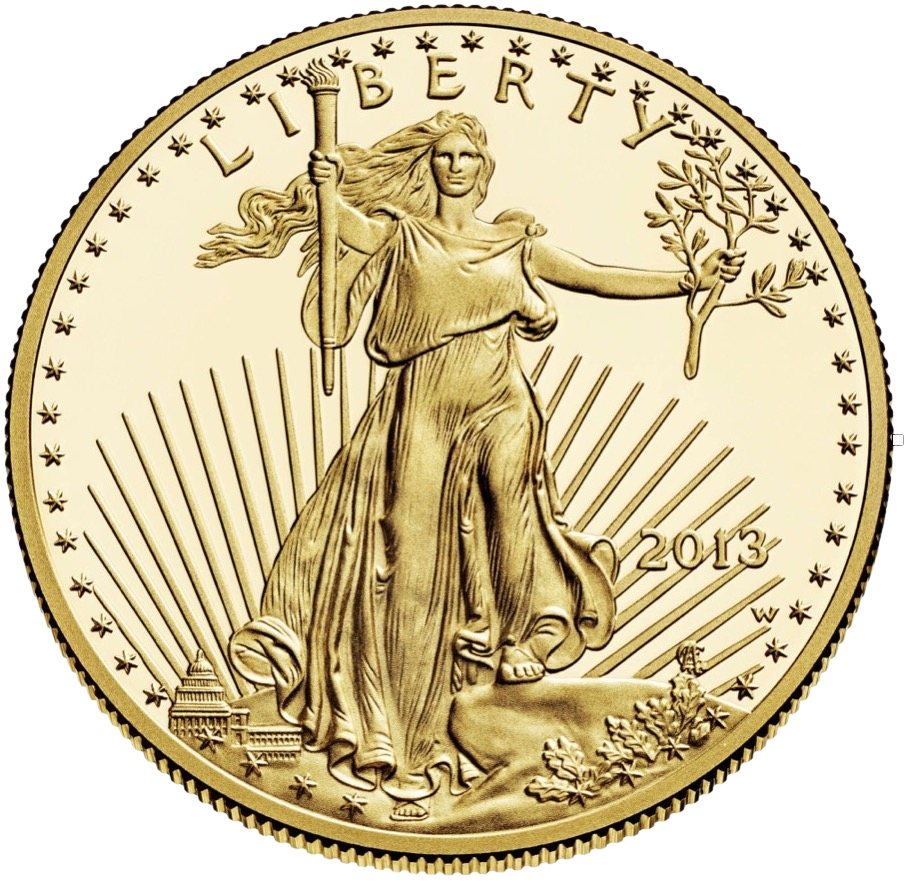
The Liberty design on the American Gold Eagle is based on the work of Augustus Saint-Gaudens, whose famous design appeared on the $20 Double Eagle in 1907. Saint-Gaudens’ Liberty shows a woman walking forward while holding a torch and olive branch.
The U.S. Capitol Building and rays of sunlight appear behind her, creating a powerful image that became one of the most recognizable designs in American coinage. Decades later, the U.S. Mint adapted this historic artwork for the American Gold Eagle, giving the modern bullion coin a direct connection to America’s classic gold coinage.
The American Gold Eagle Arrives in 1986
In 1986, the American Gold Eagle debuted as a modern U.S. gold bullion coin. It is made from 22-karat gold, containing 91.67% gold, with silver and copper making up the remaining alloy. This composition gives the coin greater durability than a 24-karat gold coin.
From the beginning, the coin was offered in four standard sizes:
- 1 oz — $50 face value
- 1/2 oz — $25 face value
- 1/4 oz — $10 face value
- 1/10 oz — $5 face value
These face values make the American Gold Eagle official U.S. legal tender, although its market value is primarily based on its gold content and applicable premiums.
The Original American Gold Eagle Reverse
From 1986 through 2021, the reverse showed a male eagle carrying an olive branch as it flew toward a nest. A female eagle and her hatchlings waited in the nest below.
The design was created by artist Miley Busiek Frost and became closely associated with the American Gold Eagle for more than three decades. The family of eagles represented themes such as family, unity, and the American spirit.
Why the American Gold Eagle Became a Familiar Bullion Coin
Several features helped establish the American Gold Eagle in the precious-metals market.
A Recognizable U.S. Mint Coin
Being produced by the United States Mint gave the coin strong recognition among American bullion buyers and collectors.
A Historic Design
The Saint-Gaudens-inspired Liberty design connected the modern coin with an important period in American coinage.
Different Size Options
Four standard sizes allow buyers to choose between fractional gold coins and the larger one-ounce version.
A Long Bullion History
Since its introduction in 1986, the American Gold Eagle has become a well-established U.S. bullion product. The U.S. Mint’s bullion-program page reports sales of more than 22 million troy ounces of American Eagle gold coins since 1986. The page does not state a reporting cutoff for this figure.
This long production history, combined with its recognizable design and U.S. Mint backing, has helped make the American Gold Eagle a familiar name among precious-metals buyers and coin collectors.
The 2021 American Gold Eagle Redesign
The American Gold Eagle entered a new design period in 2021, marking the 35th anniversary of the American Eagle Coin Program. The U.S. Mint introduced a redesigned reverse while also updating certain details on the obverse. The changes gave the coin a more modern appearance while preserving its historic character.
The New Eagle on the Reverse
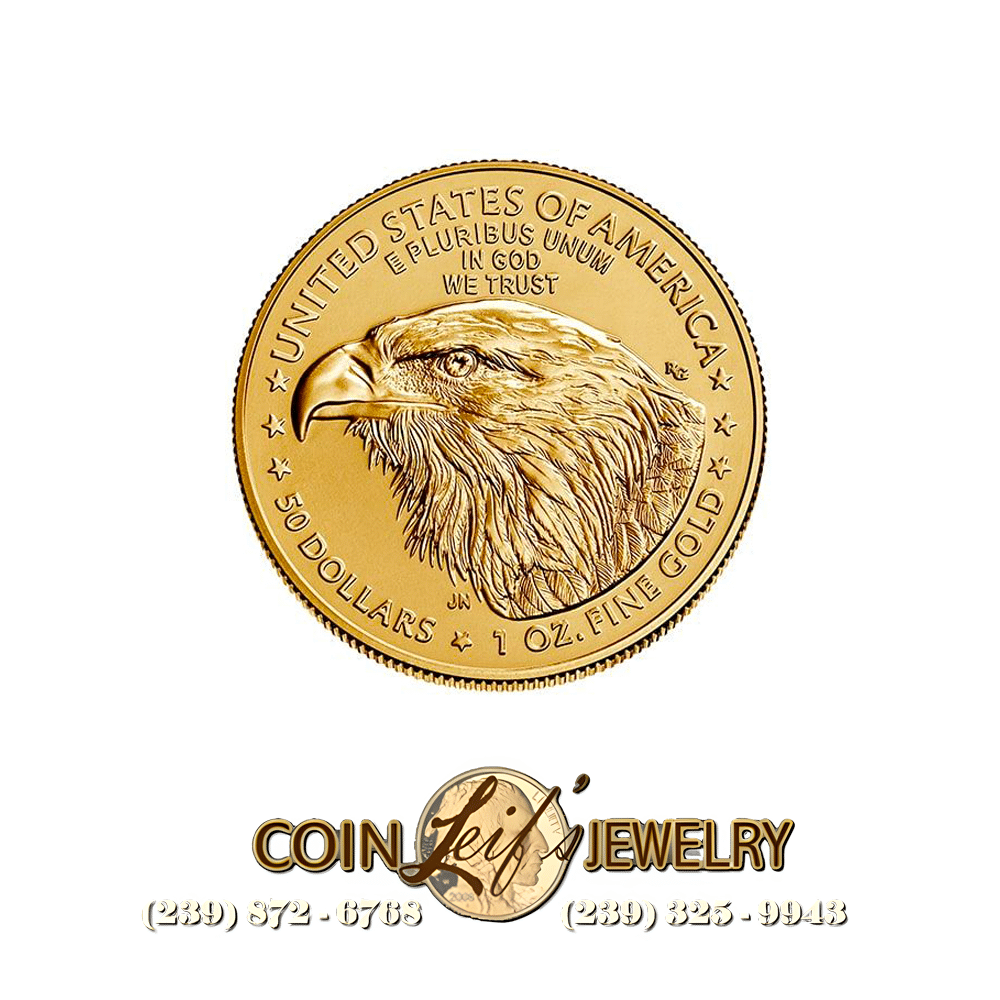
The most noticeable change appeared on the back of the coin. Instead of the earlier eagle flying toward a nest, the new reverse features a detailed close-up portrait of an eagle.
The design was created by United States Mint Artistic Infusion Program artist Jennie Norris and sculpted by Mint medallic artist Renata Gordon.
Updates to the Liberty Design
The Liberty side also received several updates. The U.S. Mint revisited historical materials connected to Saint-Gaudens’ original work, allowing designers to refine details and bring parts of the modern coin closer to the original artwork.
The updates included details involving the Capitol Building, stars, torch, sun rays, and other elements of the Liberty design.
Edge and Security Updates
The 2021 redesign also introduced a reeded-edge variation on the one-ounce Gold Eagle as an anti-counterfeiting feature. This particular edge feature does not apply to the fractional sizes. Source: U.S. Mint’s redesigned 2021 Gold Eagle announcement.
The redesign therefore changed more than the artwork. It created a clear distinction between the earlier and newer reverse designs while incorporating updated production and security considerations.
Type 1 vs. Type 2 American Gold Eagles
The 2021 redesign created two distinct design periods that collectors commonly refer to as Type 1 and Type 2.
- Type 1: The original reverse design, used from 1986 through 2021, showing a male eagle carrying an olive branch and flying toward a nest.
- Type 2: Introduced in 2021, featuring a detailed close-up portrait of an eagle on the reverse.
The easiest way to distinguish the two is by looking at the reverse design. For collectors, this distinction is useful when identifying a specific American Gold Eagle and comparing different issues.
What Makes Different Gold Eagle Issues Collectible?
The American Gold Eagle’s long production history makes different dates and design periods interesting to collectors.
Depending on the coin, collectors may consider:
- Year of issue
- Type 1 or Type 2 design
- Condition
- Proof or bullion finish
- Special editions
- Minting details
- Rarity and collector demand
As a result, two American Gold Eagles containing the same amount of gold may still attract different levels of collector interest.
American Gold Eagle vs. American Gold Buffalo
The American Gold Eagle and American Gold Buffalo are both official U.S. gold bullion coins, but they differ in composition and design.
| Feature | American Gold Eagle | American Gold Buffalo |
| Introduced | 1986 | 2006 |
| Gold purity | 91.67% | 99.99% |
| Gold karat | 22-karat | 24-karat |
| Standard 1 oz gold content | 1 troy oz pure gold | 1 troy oz pure gold |
| Main design inspiration | Saint-Gaudens’ Liberty | Buffalo Nickel |
| Reverse design | Eagle and nest / close-up eagle | American bison |
The Gold Eagle uses a 22-karat gold alloy containing silver and copper, while the Gold Buffalo is made from .9999 fine gold. The Eagle’s alloy also makes it more resistant to scratching than the softer 24-karat Buffalo.
For buyers comparing the two, the choice can come down to preferences for gold purity, design, collecting interest, and current market premiums. Premiums vary with availability, quantity, dealer pricing, and the specific issue, so equivalent coins should be compared using current market conditions. Standard bullion coins should also be compared separately from proof and other collector issues.
Is the American Gold Eagle IRA Eligible?
American Gold Eagles can be included in eligible Individual Retirement Accounts (IRAs) when applicable requirements are met. Buyers considering a self-directed precious-metals IRA should confirm the specific account, custodian, and transaction requirements before purchasing.
Qualifying holdings must meet applicable requirements and remain with the IRA custodian or trustee. For more information, see the IRS guidance on coins and bullion and IRS Publication 590-B.
Purity alone does not determine whether a holding meets all IRA requirements.
FAQs
When was the American Gold Eagle introduced?
The American Gold Eagle was introduced by the United States Mint in 1986. The first one-ounce American Gold Eagle was struck at West Point on September 8, 1986, according to the U.S. Mint’s 1986 annual report.
What are the face values of American Gold Eagles?
American Gold Eagles have face values of $5, $10, $25, and $50, corresponding to the 1/10-ounce, 1/4-ounce, 1/2-ounce, and 1-ounce sizes.
What is the difference between Type 1 and Type 2 Gold Eagles?
Type 1 Gold Eagles use the original eagle-and-nest reverse, while Type 2 Gold Eagles, introduced in 2021, feature a close-up portrait of an eagle.
Is the American Gold Eagle 24-karat gold?
No. The American Gold Eagle is 22-karat gold and contains 91.67% gold, with silver and copper making up the remaining alloy.
Can American Gold Eagles be held in an IRA?
Yes. American Gold Eagles can be included in eligible Individual Retirement Accounts when applicable requirements are met. Buyers should confirm the specific account and custodian requirements before purchasing. Qualifying holdings must remain with the IRA custodian or trustee.
The American Gold Eagle Today
The American Gold Eagle connects Saint-Gaudens’ Liberty design with a modern bullion program that began in 1986. Its four sizes, 22-karat alloy, and two reverse-design types give buyers clear features to compare. For a one-ounce coin, both the American Gold Eagle and American Gold Buffalo contain one troy ounce of gold, while their purity, gross weight, designs, and market premiums differ.
The combination of gold content, U.S. Mint production, recognizable artwork, multiple size options, and distinct Type 1 and Type 2 designs continues to make the American Gold Eagle an important U.S. bullion coin.
Buying or selling American Gold Eagles in Naples? Browse our Gold Eagle inventory or call Leif’s Coins at 239-872-6768, Monday–Friday, 9 a.m.–5 p.m., to discuss availability or your coins.